Showing posts with label change in education. Show all posts

Wednesday, August 27, 2014

The Writing Muscle

Typical Conversation 

Teacher: "Today we are going to write for..."
Students:  "ughhhhhgughsdknfadf.... whyyyyyyy??" 
Teacher/Students: (all together) "I hate my life." 

We've all been there. Writing is no fun for the students because they have to think (geez how terrible) nor for the teachers because we have to listen to endless complaining (which IS truly the definition of terrible). 

So, what do we need to do to get our kids to somewhat enjoy writing? I'm not sure if there is a silver bullet out there for that, but what I witnessed today on the 3rd day of school was nothing short of miraculous. 

A Little Background

This summer I went to a training with Gretchen Bernabei. She's A-MA-ZING! I wrote about some of the strategies I learned here. Anyway, she mentioned that her kids write everyday... and here's the kicker... they like it. WHAT? How is that even possible. I think if I walked into my classroom with the "let's write everyday" bit the conversation would go something like this:

Teacher: "Okay kids, we are going to do the first of 180 writing assignments right now. Ready?"
Students: "GET THE PITCHFORKS!!"

Seriously, how does she do that and not get murdered everyday of her life? Then she showed us some of the kids' journals. They used composition notebooks for this. If they get full, they have to buy a new one. (Hahaha... like any of my students are going to fill a notebook with solid writing.) As I flipped through, I saw the beginning pages were sparse. In fact, a lot of the kids wrote about how much they hated writing. But as I went deeper into the notebook the entries began to get longer, more involved. Then they were illustrated. Then I saw recurring characters over a long period of time. I saw notes in the margins. I saw writing come to life. It was magical. But Gretchen is magical. I could never do anything like that. Or could I...

Writing Magic

Here's how it went today:

Students entered. Read note on board: "Get out your composition notebook and a pen."

Teacher: "How many of you do any kind of physical activity?"

All but about three kids in each class raised their hands.

Teacher: "Okay. What happens if you don't do that physical activity for a long time, and then you start back up again."

Students: "You are tired, you get sore..."

Teacher: "Right, so if you don't work out your muscles, they get weak, right?"

Head nods. Glazed over eyes. 

Teacher: "Well, did you know writing is a lot like a muscle."

Students: indiscernible mumbling. I assume it was "did she really just say the W word on the 3rd day of school?"

Teacher: "The more you write the stronger you get. So, we are going to write as often as possible." (Still afraid to say "everyday.")

Students: collective eye roll, murmurs along the lines of "Are you kidding me? Writing is dumb. I've never written ever in my whole life." And so on. 

Teacher: "I am going to start a timer for ten minutes. You can't let your pencil or pen stop moving, even if that means you need to doodle a little between thoughts. Write about whatever you want. Questions?"

Crickets.

Teacher: "Ready set write."

Then, I watched and waited for the rebellion. And I waited, and waited. I only had one kid today who I had to get on to about not writing. My other 172 students scribbled away. Some took a break to stretch their fingers dramatically, but that's it. 

The Miracle

When the time ended and I said stop they asked if they could keep writing. They begged, pleaded, and snuck in a few more words after time ended. I'm serious. I wouldn't lie about something this crazy. Really, I don't think I could make it up. I kept telling them no. They had to stop writing now. Which led to their followup question: "When are we going to write like this again?" I answered, "Tomorrow and everyday after that."

And then I died and went to English teacher heaven. 

Thursday, August 7, 2014

Elementary invades Secondary

Elementary vs. Secondary

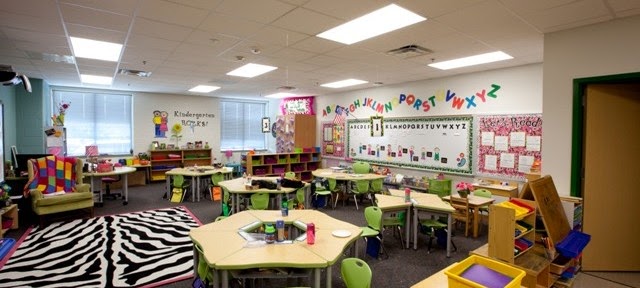
The gap between elementary and secondary isn't just middle school. For the most part, secondary teachers stay away from elementary teachers. Just walk into their respective classrooms and you'll see one reason why.

AHHHH!! MY EYES!!

Peaceful, zen, orderly... much better

And there are other reasons: their enthusiastic demeanor, endless optimism, tolerance for bodily secretions. I'm sure our sharp sarcasm, minimalistic classrooms, and constant complaints about having over a hundred kids instead of twenty-five don't do well to bridge the gap between our worlds. 

However, I don't want to discount everything they do in their classes as "little kid" stuff that would never work in my "big kid" class. After all, their little kids are still living inside every one (of my 157) kids sitting in my stark, white classroom. 

My Adventure with the Dangerous Game

I thought I'd try out one of the most famous aspects of elementary school: centers (dun-dun-duuuuunnnnnn). The first thing I realized on my road to creating centers (after I thought about how I have no space to let kids mingle about in my sardine can of a room) was they are A LOT of work. Seriously! How does any one person plan center after center throughout the year? That endless optimism must come in handy for them because geez! 

But, after I did the work I didn't have to do ANY. THING. ELSE. I just released the hounds students and they began chiseling away at their work. Sure, I had to help when we switched stations to ensure no one got lost along the way, and there were some that didn't understand the directions here and there, but for the most part they kids helped each other while I sat back and watched the magic happen. Then I thought, no wonder elementary teachers do this. It's like putting on a movie (that you made) and letting them sit and watch it. 

Get it here.
I plan to use more centers this year, and I'm going to start my year with this one I made for Richard Connell's "The Most Dangerous Game." I am going to make a few changes this year. Last year, we read the story without stopping to talk about anything. Just plowed right on through. As an English teacher that was hard, but the point is to let the students discover meaning on their own, not spoon-feed it to them, so leave your spoons at home. After reading, I gave the students numbers 1-9. Whichever number they got, that's where they began. We did three centers per day, but that wasn't really enough time for the kids to finish each station so I have a lot of them in tutoring to get done. This year, I'll probably do two centers per day. It doesn't matter what order the centers are done in either. At the end, they turn in every paper with a silhouette of an island on the bottom. It's that easy. And the grading wasn't too bad either. 

The best thing I learned from doing centers was that I shouldn't stay away from those bubbly elementary teachers. They could have just the thing my classroom is missing. And I don't mean thousands of colors. 

Happy teaching!

Wednesday, May 7, 2014

Innovating the Wheel

Our Profession

If I had a penny for every time I heard a colleague say, "There's no reason to reinvent the wheel..." (followed by handing me a lesson from 1972) then I wouldn't have to be a teacher anymore.

Teaching is the only profession I know of where people believe if one activity or lesson didn't work one year, then it might work the next year because different students are doing the assignment. That's like saying when I punched Bob in the face, he punched me back. Now, I'll go punch Kevin in the face and hope he gives me a hug. Any sane person would tell you to just stop punching people in the face and your problems will be solved. So, all of us insane teachers who believe "it'll work next year" need to take a hint from the sane people in our lives. Find something else to do and life will get better. Or it won't. In that case, keeping finding that "something else" until it finally works.

Innovation

Sir Ken Robinson explains the problems we have with education best. Watch this. You'll laugh, you'll cry...

If Alexander Graham Bell hadn't thought we needed a new way to communicate, we wouldn't have phones. If The Wright Brothers hadn't believed we needed a new way of travel, we would have planes. If Al Gore Robert Kahn and Vint Cerf hadn't thought we needed a better place to store knowledge/communicate, we wouldn't have the internet. 

These people all have one thing in common. They were underwhelmed by the status quo. Sending letters via envelopes and/or courier pigeons wasn't wrong. It got the job done, but someone found a better way. 

What we have been doing in the classroom (since the 19th century) isn't wrong. But there's GOT to be a better way. Something more efficient, more powerful, more meaningful. It's out there, we just have to discover it. My feeling is that there are only a few who are looking for it, and that scares me. 

The Problems with Innovation

There are two really. Teachers love what is familiar. That worksheet from seventeen years ago in my filing cabinet is safe, it's familiar. I don't even need a key anymore because it's stored in my brain. In fact, I just checked and I don't even need to make copies. My past self did that for me twelve years ago. Done and done. 

The second issue with innovation is teachers fear change. Just think back to the year before TOSS turned into TAKS. And in the more recent past when TAKS turned into STAAR. Teachers flipped the heck out. Change is scary for everyone, but it has a special place in every teacher's heart. 

So, how do we fix these nagging problems to innovation? I say it's really easy. Just stop it! Teachers won't fall over and die if we have a bonfire for all those ancient worksheets multiplying in our filing cabinets. The heavens won't fall if we try something new and it fails. In fact, I am a FIRM believer in letting the kids see us fail. How will they learn to succeed if no one teaches them to fail? 

My Mission

In the past year my mission obsession has been searching for lessons and activities that would engage my lumps of anti-motivation into little thinkers that can and want to succeed. So far, my journey has taken me through Pinterest, blogs, TED Talks, brain research and beyond. I will not claim to have the answers (yet), but I think I am going in the right direction. Step away from your worksheets and join me, won't you?