Showing posts with label freshmen. Show all posts

Thursday, August 7, 2014

Elementary invades Secondary

Elementary vs. Secondary

The gap between elementary and secondary isn't just middle school. For the most part, secondary teachers stay away from elementary teachers. Just walk into their respective classrooms and you'll see one reason why.
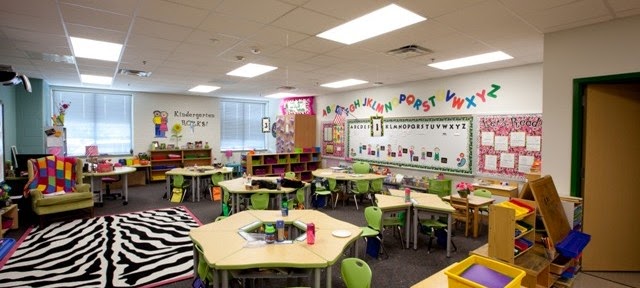
AHHHH!! MY EYES!!

Peaceful, zen, orderly... much better

And there are other reasons: their enthusiastic demeanor, endless optimism, tolerance for bodily secretions. I'm sure our sharp sarcasm, minimalistic classrooms, and constant complaints about having over a hundred kids instead of twenty-five don't do well to bridge the gap between our worlds. 

However, I don't want to discount everything they do in their classes as "little kid" stuff that would never work in my "big kid" class. After all, their little kids are still living inside every one (of my 157) kids sitting in my stark, white classroom. 

My Adventure with the Dangerous Game

I thought I'd try out one of the most famous aspects of elementary school: centers (dun-dun-duuuuunnnnnn). The first thing I realized on my road to creating centers (after I thought about how I have no space to let kids mingle about in my sardine can of a room) was they are A LOT of work. Seriously! How does any one person plan center after center throughout the year? That endless optimism must come in handy for them because geez! 

But, after I did the work I didn't have to do ANY. THING. ELSE. I just released the hounds students and they began chiseling away at their work. Sure, I had to help when we switched stations to ensure no one got lost along the way, and there were some that didn't understand the directions here and there, but for the most part they kids helped each other while I sat back and watched the magic happen. Then I thought, no wonder elementary teachers do this. It's like putting on a movie (that you made) and letting them sit and watch it. 

Get it here.
I plan to use more centers this year, and I'm going to start my year with this one I made for Richard Connell's "The Most Dangerous Game." I am going to make a few changes this year. Last year, we read the story without stopping to talk about anything. Just plowed right on through. As an English teacher that was hard, but the point is to let the students discover meaning on their own, not spoon-feed it to them, so leave your spoons at home. After reading, I gave the students numbers 1-9. Whichever number they got, that's where they began. We did three centers per day, but that wasn't really enough time for the kids to finish each station so I have a lot of them in tutoring to get done. This year, I'll probably do two centers per day. It doesn't matter what order the centers are done in either. At the end, they turn in every paper with a silhouette of an island on the bottom. It's that easy. And the grading wasn't too bad either. 

The best thing I learned from doing centers was that I shouldn't stay away from those bubbly elementary teachers. They could have just the thing my classroom is missing. And I don't mean thousands of colors. 

Happy teaching!

Sunday, August 3, 2014

Expository: Fight the Boring

It doesn't have to be painful...

I have a confession to make. I hate reading expository texts. There, I said it. Unfortunately, Texas has decided that expository is the mother of all writing. So, here I am a few weeks away from the beginning of school and I am thinking about the one thing I hate the most. 

What is it about expository that makes it so awful uninteresting to me? I mean, I really like watching documentaries, the news, listening to NPR. All of those are expository texts. Non-fiction and informational. All the things I say I don't like. But I can't get enough. I am such a news junkie that my two year old asks to watch the news instead of cartoons. So, it can't be the "entertainment value" that turns me off to cracking open an article and reading it. It must be something else. 

I went to my thinking spot and thought, thought, thought, and I realized. I just don't like teaching non-fiction. Usually when faced with teaching an article, I don't know what to do beyond read it and talk about it. How boring for everyone involved in the process of learning. 

Proposed Solution

First, I have to chose expository texts that are high interest. The internet will help me out with that I'm sure. I used one last year about the Shia and Sunnis using Romeo and Juliet to change Iraq (It's FREE). The kids really liked it. But I didn't do a great job of teaching the article. At the end of the unit, I patted myself on the back for working non-fiction in to the Romeo and Juliet unit, but I could totally do better. 

Secondly, I need a WAY of teaching the text that allows the students to take ownership of what they are reading and eventually turn reading into writing. Easier said than done, I know. But I created this graphic organizer as a start. It can be used with any expository text. And I think it can be used in elementary, middle, and secondary classrooms. So far, it's a step in the right direction. 

In conclusion

Step 1: high interest texts
Step 2: a guide to analyzing the high interest text that leads to writing

Let me know how you integrate non-fiction articles in your curriculum and what you use to do it. 

Until then, happy teaching!!

Friday, May 9, 2014

Conquering the Sonnet

Get this lesson here


The Shakespeare Blues

When I was in high school, I took a Shakespeare class and it was my FAVORITE. My teacher was AMAZING!!! So, when I became a teacher, I hoped that I could make Shakespeare as engaging as my teacher did, but I've decided I don't have the same super power he did. The last few years have been rough. In fact, when we get to the part where Romeo finally dies, most of my classes applaud, me included. I needed to do something different before I had a full on riot on my hands. 


Sonnet Balderdash

Introducing sonnets doesn't have to be boring. Although my kiddos are too young to remember the board game Balderdash, they picked up the rules pretty quickly. You can use any sonnet with this, but choosing one with some salty language makes them realize Shakespeare isn't as boring as they previously thought. Directions are included here

When I do this, I line my desks into rows. The person farthest from the middle aisle is "it." After they write the paraphrase on the group paper, they pass it to the middle. Usually I count down from ten so they don't take four years to write something. Any team without a paper when I get to one is disqualified. Also, group members can't help the "it" person. Each round, the students move seats so everyone gets a change to be "it".

After playing this once, my students request this game. Let me repeat, they ask to read more sonnets. 

Behold, the Visual Sonnet

Downfall of this project = messy room.
My second solution to the Shakespeare blues was actually stealing using a lesson from my high school class. We worked in groups to visually represent a sonnet we were assigned. We did Sonnet 19, and I will never forget it. We had colored lights, a hula hoop bedecked with red and orange streamers, a tiger, a lion. It was EPIC. And that high school memory has never left me. For years, I wanted to do the project, but was too afraid I wouldn't be able to pull it off in my classroom. This year, I sucked it up and just did it. I used this YouTube video to introduce the project. I do not expect them to create shadow figures like this one, but it shows how the dancers create images from the spoken word. You can find the entire assignment here for free!!

This is something you can NEVER unsee.

The Dark Lady
This project can be used as an introduction to Shakespeare's language or as a culminating activity. I used it at the end of our Romeo and Juliet unit (which I will poster later. I actually had fun this year with it. Update: the month long lesson unit is posted here.) I wanted to test their ability to paraphrase the language and my kiddos did pretty well. If this project is at beginning of a unit, they will struggle more and need your support. 

By the end of this project, each group has practically memorized a sonnet (but I don't tell them that.) Also, each student recognizes the power of imagery in poetry. Can't get better than that, right?

Wednesday, May 7, 2014

Innovating the Wheel

Our Profession

If I had a penny for every time I heard a colleague say, "There's no reason to reinvent the wheel..." (followed by handing me a lesson from 1972) then I wouldn't have to be a teacher anymore.

Teaching is the only profession I know of where people believe if one activity or lesson didn't work one year, then it might work the next year because different students are doing the assignment. That's like saying when I punched Bob in the face, he punched me back. Now, I'll go punch Kevin in the face and hope he gives me a hug. Any sane person would tell you to just stop punching people in the face and your problems will be solved. So, all of us insane teachers who believe "it'll work next year" need to take a hint from the sane people in our lives. Find something else to do and life will get better. Or it won't. In that case, keeping finding that "something else" until it finally works.

Innovation

Sir Ken Robinson explains the problems we have with education best. Watch this. You'll laugh, you'll cry...

If Alexander Graham Bell hadn't thought we needed a new way to communicate, we wouldn't have phones. If The Wright Brothers hadn't believed we needed a new way of travel, we would have planes. If Al Gore Robert Kahn and Vint Cerf hadn't thought we needed a better place to store knowledge/communicate, we wouldn't have the internet. 

These people all have one thing in common. They were underwhelmed by the status quo. Sending letters via envelopes and/or courier pigeons wasn't wrong. It got the job done, but someone found a better way. 

What we have been doing in the classroom (since the 19th century) isn't wrong. But there's GOT to be a better way. Something more efficient, more powerful, more meaningful. It's out there, we just have to discover it. My feeling is that there are only a few who are looking for it, and that scares me. 

The Problems with Innovation

There are two really. Teachers love what is familiar. That worksheet from seventeen years ago in my filing cabinet is safe, it's familiar. I don't even need a key anymore because it's stored in my brain. In fact, I just checked and I don't even need to make copies. My past self did that for me twelve years ago. Done and done. 

The second issue with innovation is teachers fear change. Just think back to the year before TOSS turned into TAKS. And in the more recent past when TAKS turned into STAAR. Teachers flipped the heck out. Change is scary for everyone, but it has a special place in every teacher's heart. 

So, how do we fix these nagging problems to innovation? I say it's really easy. Just stop it! Teachers won't fall over and die if we have a bonfire for all those ancient worksheets multiplying in our filing cabinets. The heavens won't fall if we try something new and it fails. In fact, I am a FIRM believer in letting the kids see us fail. How will they learn to succeed if no one teaches them to fail? 

My Mission

In the past year my mission obsession has been searching for lessons and activities that would engage my lumps of anti-motivation into little thinkers that can and want to succeed. So far, my journey has taken me through Pinterest, blogs, TED Talks, brain research and beyond. I will not claim to have the answers (yet), but I think I am going in the right direction. Step away from your worksheets and join me, won't you?